
 What is happening to the NHS and to UK medicine generally? Why are so many doctors — and patients — unhappy?
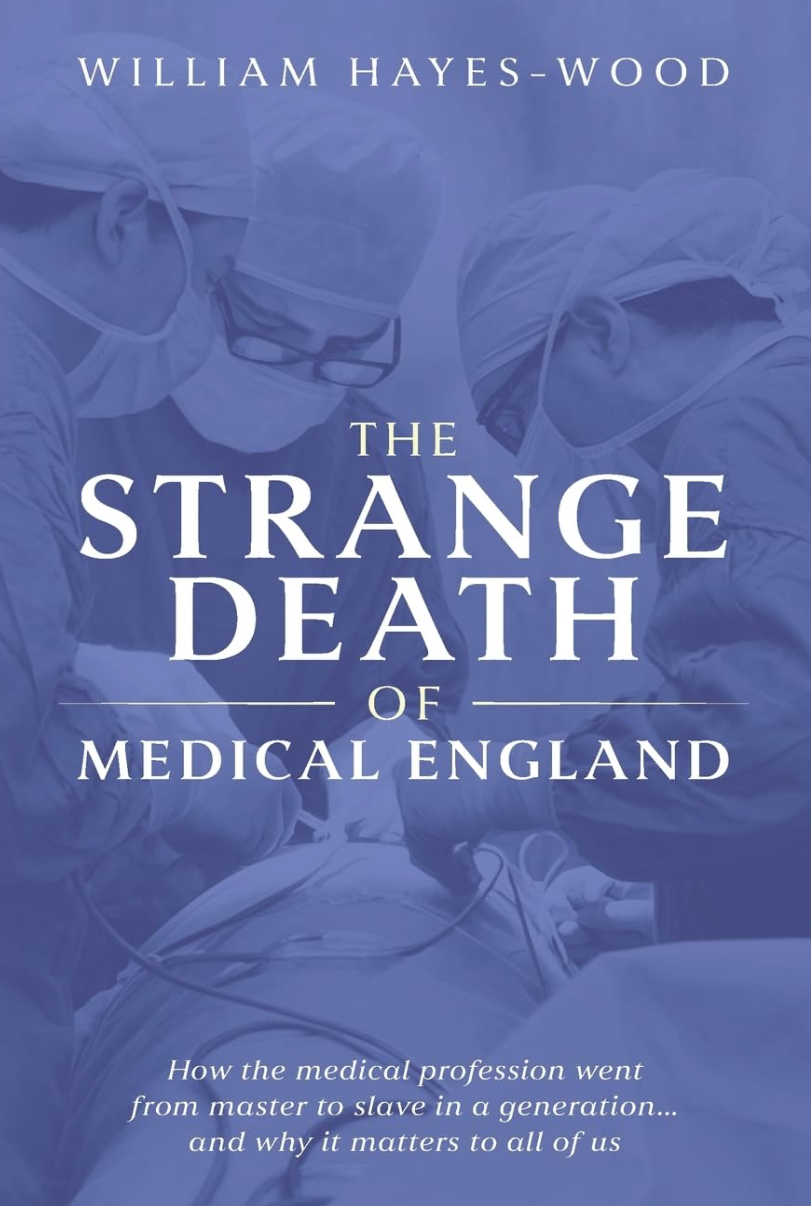
The Strange Death of Medical England: How the medical profession went from master to slave in a generation and why it matters to all of us
William Hayes-Wood, 2025, 123pp. (£7.99, paperback)
This short and readable book, aimed at a general audience, explains how the profession has been attacked in a deliberate, methodical and stealthy way by various governments from Mrs Thatcher onwards in order to curb the power and influence which might have frustrated political plans.
A retired surgeon, Mr Hayes-Wood has a 40 year experience of the NHS, beginning as a nursing assistant before becoming a medical student. He describes the way that neoliberal policies, introduced by Mrs Thatcher, are threatening the NHS and UK medicine.
As a student and a junior doctor, the author took little interest in political aspects of healthcare, but while a new consultant in the 1980s a TV programme suddenly shocked him by claiming that the NHS was too expensive to continue in its present form. Doctors, it seemed, were responsible for this because of profligate spending, so must be removed from positions of power or influence. This, he later realised, reflected the thinking of Mrs Thatcher’s government—but was only the beginning of their plans for control of doctors and the NHS. International comparisons, however, showed that the NHS, rather than being profligate, was actually extremely efficient, but, as he says, ‘a determined politician never lets the truth get in the way of a favoured policy’.
Mrs Thatcher, advised by businessman Roy Griffiths, introduced well-paid managers from the private sector to the NHS. Doctors became closely involved with local management as a result of the 1983 Griffiths report, and their involvement in corporate decision-making reduced their professional independence so they were unable to veto unsatisfactory policies. Almost all UK doctors at this point had known the NHS all their working lives and supported it strongly .
After Mrs Thatcher’s third election victory in 1987, another review, aimed at cutting costs by bringing in competition, introduced the internal market. GPs would become fundholders, and hospitals would act as individual businesses, later ‘Trusts’.
New Labour’s 1997 victory brought in a welcome and necessary increase in NHS funding, but neoliberal policies otherwise continued and election promises were soon broken. Private-sector involvement continued to increase, including the shockingly expensive Private Finance Initiative.
More reorganisations (or redisorganisations) followed, such as the 2012 Health and Social Care Act, described by Lord Darzi as ‘a calamity without international precedent’. Medical pay was gradually eroded, and growing unrest among doctors led to medical strikes.
The fourth chapter deals with how doctors are regulated so that patients can be confident that they are properly trained. A muddle of 19 different organisations, including the Church of England, was replaced in 1858 by the GMC whose members, all doctors, were elected by their peers. Lay people were brought in to the GMC Council in 2003 under New Labour and it is now under political control, with all Council members, including doctors, appointed by the Privy Council. Charlie Massey, the GMC Chief Executive, is also a Government appointment. Doctors are therefore more reluctant to speak out about worrying issues. There is a tendency to blame the doctor when things go wrong, rather than the lack of staff or facilities which is really responsible but which could be seen as criticism of the Government.
Since 2024, the GMC has kept a register of non-doctors—physician associates and anaesthetic associates—as well as doctors. In the author’s words, it is doing exactly what it was set up to prevent as it makes it difficult to be sure who is medically qualified. Government control of the GMC, he feels, was a tipping point, meaning that ‘the concept of an independent self-governing profession has gone’.
The Blair government launched ‘Modernising Medical Careers’ in 2005, bringing in sweeping changes to postgraduate training, particularly for hospital specialties. This became centrally organised and far more prescriptive, so young doctors were expected to choose a training programme straight after their two foundation years. They could no longer experience a variety of specialties until they felt ready to enter a training scheme after which they could apply for a consultant post. The result is that new consultants now have a much narrower training and considerably less clinical experience than in the past.
The Government and its agents now control the allocation of doctors’ jobs, causing much unhappiness among young doctors. More medical students are now qualifying, but the numbers of training posts for general practice or for hospital specialties has barely increased, so that doctors finishing foundation training are faced with unemployment. Some have emigrated and others have left medicine. In the author’s opinion, there has been a clear intention to show that doctors are no longer an independent profession and are under government control. This control is also shown in allocation of foundation jobs. Little account is taken of individual wishes or family commitments, and new doctors may be expected to move to distant cities at very short notice.
Another way to reduce the power and influence of doctors is to replace them with other, less well-qualified, staff. Physician Associates, with only a two year training ,were supposedly introduced as assistants to help doctors but it gradually became clear that this was not the intention. GP practices were given strong financial incentives to employ PAs and other non-medical staff and the GMC has stated an intention to use PAs as ‘medical role substitutes’. Although much better paid than many young doctors, they are also cheaper to employ than fully trained GPs, many of whom cannot find work in spite of a serious shortage of GP appointments. The wishes of patients, and the serious clinical risks of this policy, are ignored.
How did we fail to see what was happening? Mrs Thatcher confronted the miners and steelworkers directly, but the NHS has always been immensely popular and so a stealthier approach was needed. Almost all doctors strongly supported the NHS and naively assumed that any government would feel the same. We had not recognised that the villain here, neoliberalism, had become the driving force behind both our major parties, so the profession had become ‘an obstacle which had to be crushed’.
Consultants have often been to blame in failing to oppose damaging changes, although doing so can, of course, be unhelpful to careers. Likewise, the Royal Colleges, which should be guarding professional standards, have been far too reluctant to criticise Government plans. The RCP London, which started a Faculty of Physician Associates (now closed after pressure from Fellows) is particularly culpable here, but most, in particular the RCGP, have been complicit.
What of the future? The author sees ‘more of the same’, with increasing use of the private sector and insufficient funding. Doctors will increasingly be replaced by PAs and other under-trained and more malleable staff, so that NHS general practice and A+E will be staffed by non-doctors, bringing in a two-tier service for those, such as GMC employees (who all have private health insurance provided) who can afford more expert care.
What can we do? The government, he feels, will continue along the current path unless public pressure becomes too strong.
Doctors, now tightly controlled, are unable to help. But how can the public know what is happening?
After the Medical Act of 1858, anyone working as a doctor was obliged, for the first time, to be on a national register which was only open to those with proper training and qualifications, so unqualified ‘quacks’ could be avoided. But now, in 2025, a patient attending the GP surgery or hospital may encounter a variety of people who they may think are doctors, who will make a diagnosis—and possibly order lots of tests as they have no idea what is happening—and plan treatment, all without a qualified doctor being involved.
We have come full circle. As Hayes Wood says, the GMC is supporting exactly what it was put in place to prevent.
Andrea Franks
EC member, DFNHS